
The price in every unit
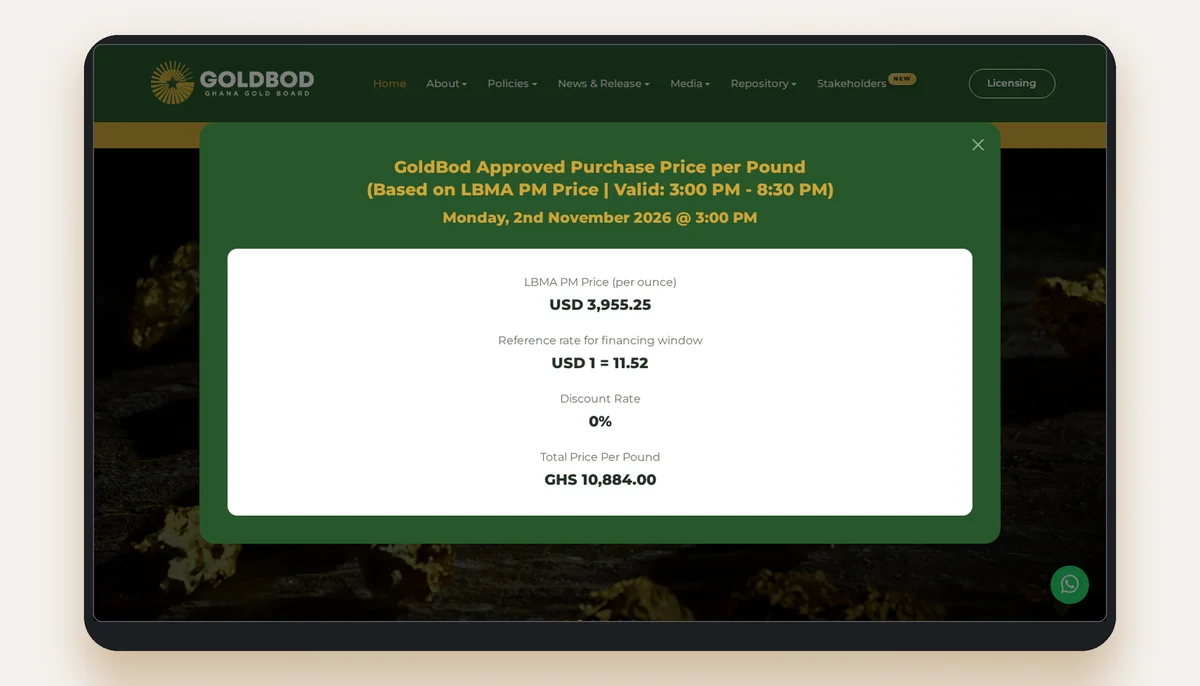
The GoldBod approved purchase price is published per pound. The table above shows that price in cedis, with the gram and troy ounce figures that follow from the same LBMA price and cedi reference rate. A world comparison at the Bank of Ghana's interbank rate sits beside them.
One price, three weights
The GoldBod price for a pound, a gram and an ounce, and the same weight of world gold at the interbank rate.
| Weight | GoldBod price | World metal at the interbank rate | Difference |
|---|---|---|---|
| 1 pound (GoldBod unit) | GH₵10,884.00 | GH₵10,985.22 | GH₵-101.22 |
| 1 gram | GH₵1,464.93 | GH₵1,478.56 | GH₵-13.62 |
| 1 troy ounce | GH₵45,564.48 | GH₵45,988.21 | GH₵-423.73 |
Price of: 02.11.2026
The pound is the board's own unit
The Ghana Gold Board publishes one approved purchase price per pound. That is the price licensed buyers must pay for gold of the board's stated fineness. The pound here is not the avoirdupois pound of 453.6 grams; it is a traditional Ghanaian gold pound whose weight the board does not state. The table above takes the board's published pound price as its starting point.
The gram and troy ounce rows are not separately published by the board. They are worked from the same LBMA dollar price and the same cedi reference rate that the board uses to set the pound price. That means the three rows move together: if the LBMA price moves, or the reference rate moves, all three cedi figures move by the same proportion. The troy ounce is the standard international unit for gold; the gram is the unit a licensed buyer's scale will use.
What the columns show
The table above has a column for the GoldBod pound price in cedis, a column for the gram price that follows from the same inputs, and a column for the troy ounce price worked the same way. Beside them is a world-metal column: the world gold price in US dollars multiplied by the Bank of Ghana's interbank mid rate. That column is a comparison, not a price at which anyone is obliged to buy or sell.
The pound price is the one figure the board publishes. The gram and ounce rows are implied by the board's own arithmetic, and the weight of the pound is implied as well. A reader should not take the gram figure as a rate that a licensed buyer will quote, because a buyer will assay the metal and pay on the actual fineness and weight. The table is a translation of the board's headline into the other units commonly used.
Why the world comparison sits beside it
The world-metal column shows what the same troy ounce would be worth at the Bank of Ghana's interbank rate. The interbank rate is not the rate the board uses; the board's reference rate is shown elsewhere on this site and can differ. Putting the two side by side shows the effect of the cedi conversion alone.
When the approved price is below the world comparison, part of the gap is the board's reference rate being weaker than the interbank rate, and part may be a discount the board applies. When the approved price is above the world comparison, the reference rate may have strengthened or the LBMA price may have moved differently. The table does not explain the gap; it shows it. A seller should look at the gap and ask the licensed buyer for a written breakdown of the rate and any discount applied.
The pound weight is implied, not stated
The board does not state what a pound weighs. This site works out the implied weight by dividing the published pound price by the gram price that follows from the same LBMA price and cedi reference rate. That implied weight is shown in the table and labelled as implied. It is the best available reading of what the board means by a pound.
A seller should not assume that a physical pound of gold will weigh exactly the implied figure. The traditional Ghanaian pound has varied over time and by region. A licensed buyer's scale will weigh the metal in grams, and the buyer will pay on the assayed fineness. The implied weight is a check on the board's arithmetic, not a promise about any particular lot.
What a seller should ask for in writing
Before handing over gold, a seller should ask the licensed buyer for a written offer that shows the weight in grams, the fineness after assay, the price per gram, and the total in cedis. The offer should also state the reference rate used and any discount applied to the LBMA price. That written offer is the basis for comparing with the approved price on the board's page.
A buyer who will not put the terms in writing should be avoided. The GoldBod approved purchase price is the minimum, but a buyer's slip may differ because the fineness is lower than the board's stated fineness, or because the weight is different. The written offer makes those adjustments explicit. The table above gives the headline; the written offer gives the actual transaction.
The troy ounce is the international unit
The troy ounce is the unit used for the LBMA price. The gram is the unit used by a licensed buyer's scale. The pound is the unit the board publishes. All three are shown in the table above, with the troy ounce and gram worked from the same LBMA price and cedi reference rate as the pound.
A reader who is used to the troy ounce should not expect the pound price to be a simple multiple of the ounce price, because the pound's weight is not the avoirdupois pound. The implied weight shown in the table is the link between them. A reader who is used to grams should look at the gram figure as the closest to what a scale will show, but should remember that the buyer will assay and pay on fineness.
Key facts on the units
More on the GoldBod price
Questions about the gold price
q
Is the pound price the same as the gram price multiplied by the implied weight?
a
Yes, because the gram price and the pound price are both worked from the same LBMA price and cedi reference rate. The implied weight is the pound price divided by the gram price, so multiplying the gram price by the implied weight gives the pound price. That is arithmetic, not a board statement.
q
Why is the world comparison different from the GoldBod price?
a
The world comparison uses the Bank of Ghana's interbank mid rate, while the GoldBod price uses the board's reference rate. The two rates can differ, and the board may also apply a discount to the LBMA price. The difference between the two columns shows the combined effect of those choices.
q
Can I sell gold at the gram price shown in the table?
a
The gram price is implied from the board's inputs, not a separate published price. A licensed buyer will weigh your gold in grams, assay it for fineness, and pay on the actual fineness and weight. The table's gram figure is a reference, not an offer.
q
What does 'implied weight' mean?
a
It means the weight that would make the board's published pound price equal to the gram price times that weight. The board does not state what a pound weighs, so this site works out the weight from the board's own figures. It is labelled implied because it is a derived figure, not a board statement.
q
Should I use the troy ounce or the gram for my gold?
a
A licensed buyer in Ghana will weigh your gold in grams and pay on the assayed fineness. The troy ounce is the international unit for the LBMA price, but it is not what a local scale will show. The gram figure in the table is the closest to a local transaction, but the final price depends on assay.
Trade the gold price with FxPro
A contract for difference on gold settles in your account's currency and carries no claim on any metal. Opening an account requires identification and takes a day or two. A practice account costs nothing.